

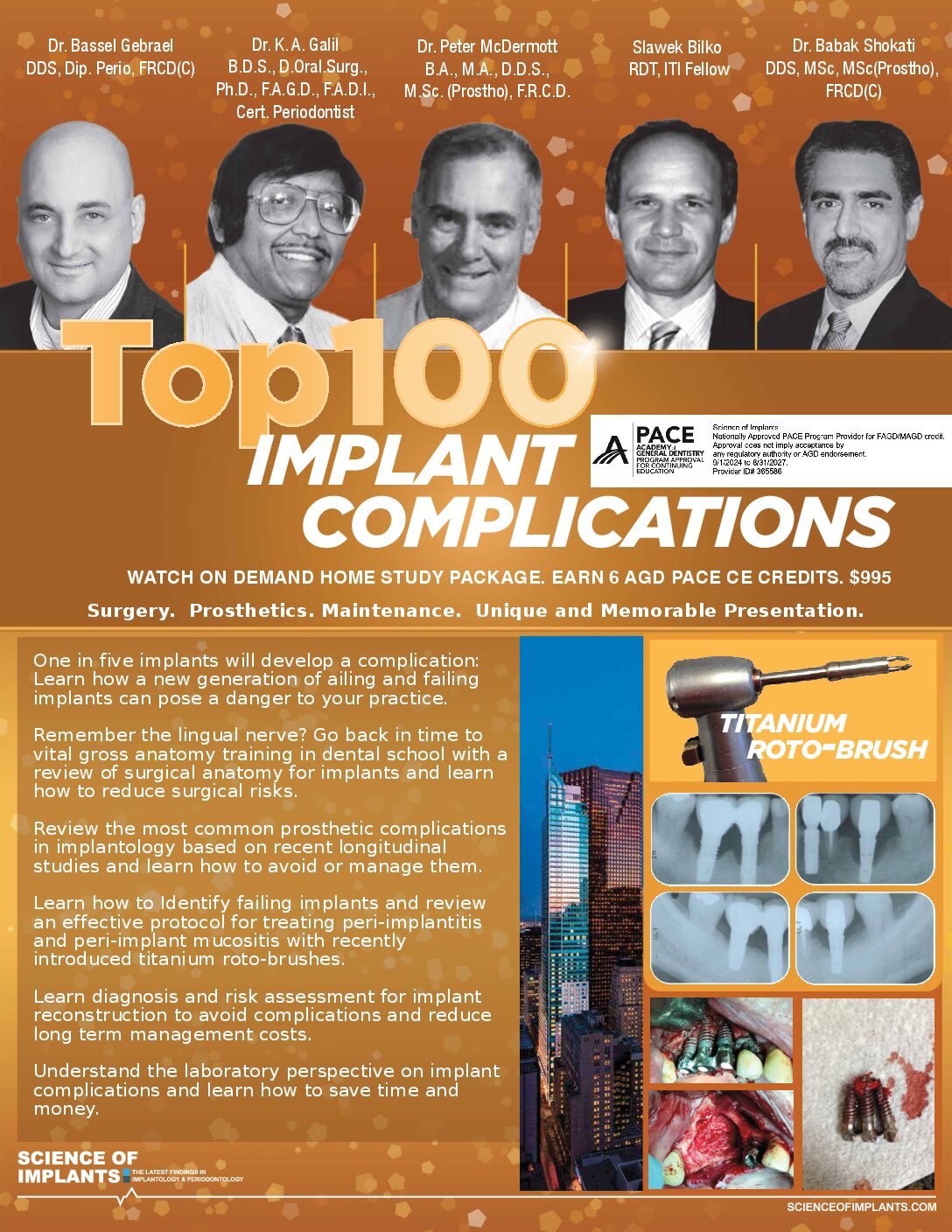
THIS INSTRUCTIONAL WEBINAR CE COURSE CONTAINS A FULL DAY SEMINAR ON SURGICAL, PROSTHETIC, AND LABORATORY RELATED IMPLANT COMPLICATIONS AND THE MANAGEMENT OF PERI-IMPLANTITIS

Complete the enclosed self-assessment quiz to receive 6 AGD PACE CE credits
Course Objectives:
One in five implants will develop a complication: Learn how a new generation of ailing and failing implants can pose a danger to your practice.
Remember the lingual nerve? Go back in time to vital gross anatomy training in dental school with a review of surgical anatomy for implants and learn how to reduce surgical risks.
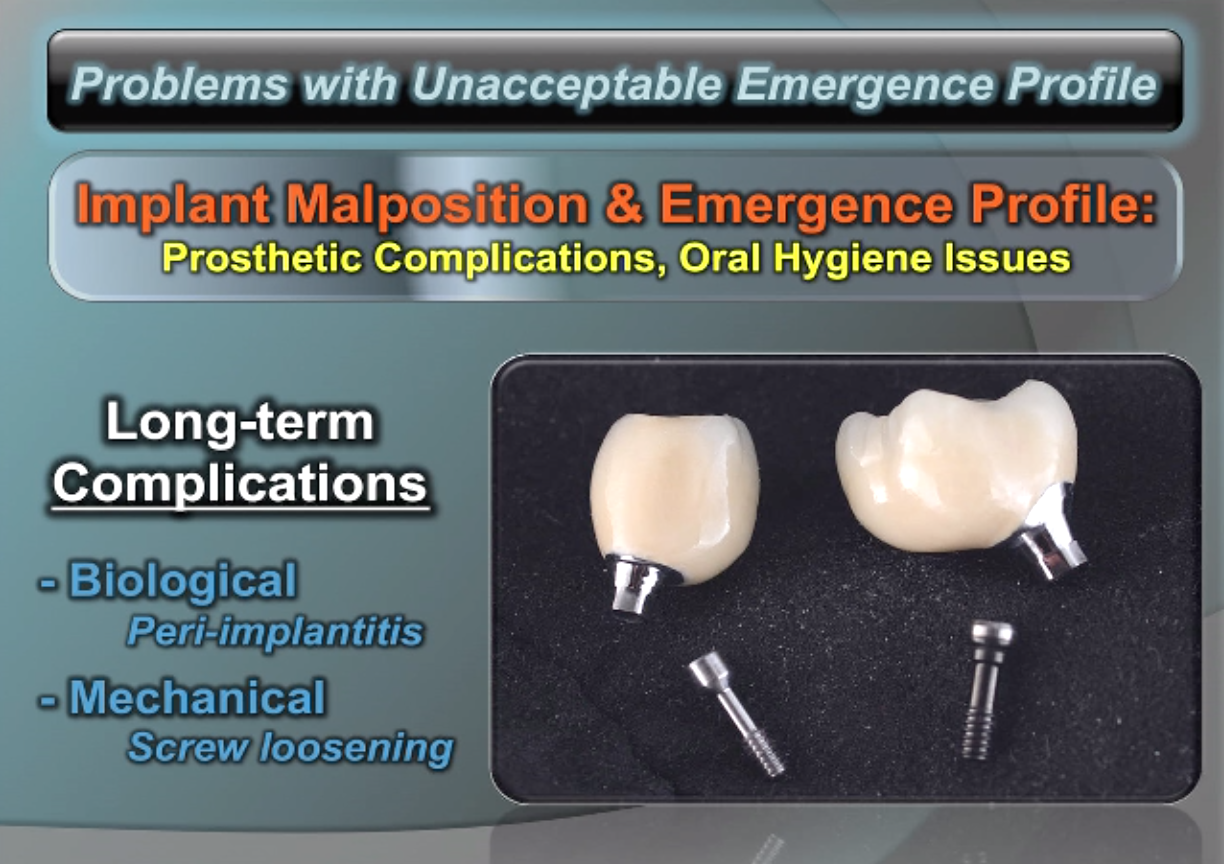
Review the most common prosthetic complications in implantology based on recent longitudinal studies and learn how to avoid or manage them.
Learn how to Identify failing implants and review an effective protocol for treating peri-implantitis and peri-implant mucositis with recently introduced titanium roto-brushes.
Learn diagnosis and risk assessment for implant reconstruction to avoid complications and reduce long term management costs.
Understand the laboratory perspective on implant complications and learn how to save time and money.
Course Instructors: Dr. Bassel Gebrael, DDS, Dip. Perio, FRCD(C), Dr. K. A. Galil, B.D.S., D.Oral.Surg., Ph.D., F.A.G.D.,
F.A.D.I., Cert. Periodontist, Slawek Bilko, RDT, ITI Fellow, Dr. Babak Shokati, DDS, MSc, MSc, FRCD(C).
Top 100 Implant COMPLICATIONS ARE LISTED BELOW:
- PROSTHETIC COMPLICATIONS IN Implantology:
1 Abutment loosening in implant Supported-Fixed Partial/Complete Prostheses. Prosthesis is stable but, tissue is inflamed/painful. Overgrowth of tissue between the components. Pinched tissue, Pain with every bite
2 Lack of passivity due to improper impression. Porcelain fracture
3 Inadequate vertical restorative space, thin acrylic covering overdentures’ attachments. Fracture of the acrylic
4 Inadequate acrylic thickness around the abutment cylinders of Hybrid IS-prostheses. Denture tooth debonding
5 Residual cement in cement-retained restorations. Severe marginal bone loss
6 Abutment screw loosening in cement-retained restorations. inability to retrieve and tighten the screw.
7 Transition line problem in Implant-supported complete fixed prostheses (ICFDP). Violation of esthetic principles
8 Oral hygiene problem in Implant-supported complete fixed prostheses (ICFDP). Inflammation tissue under prostheses
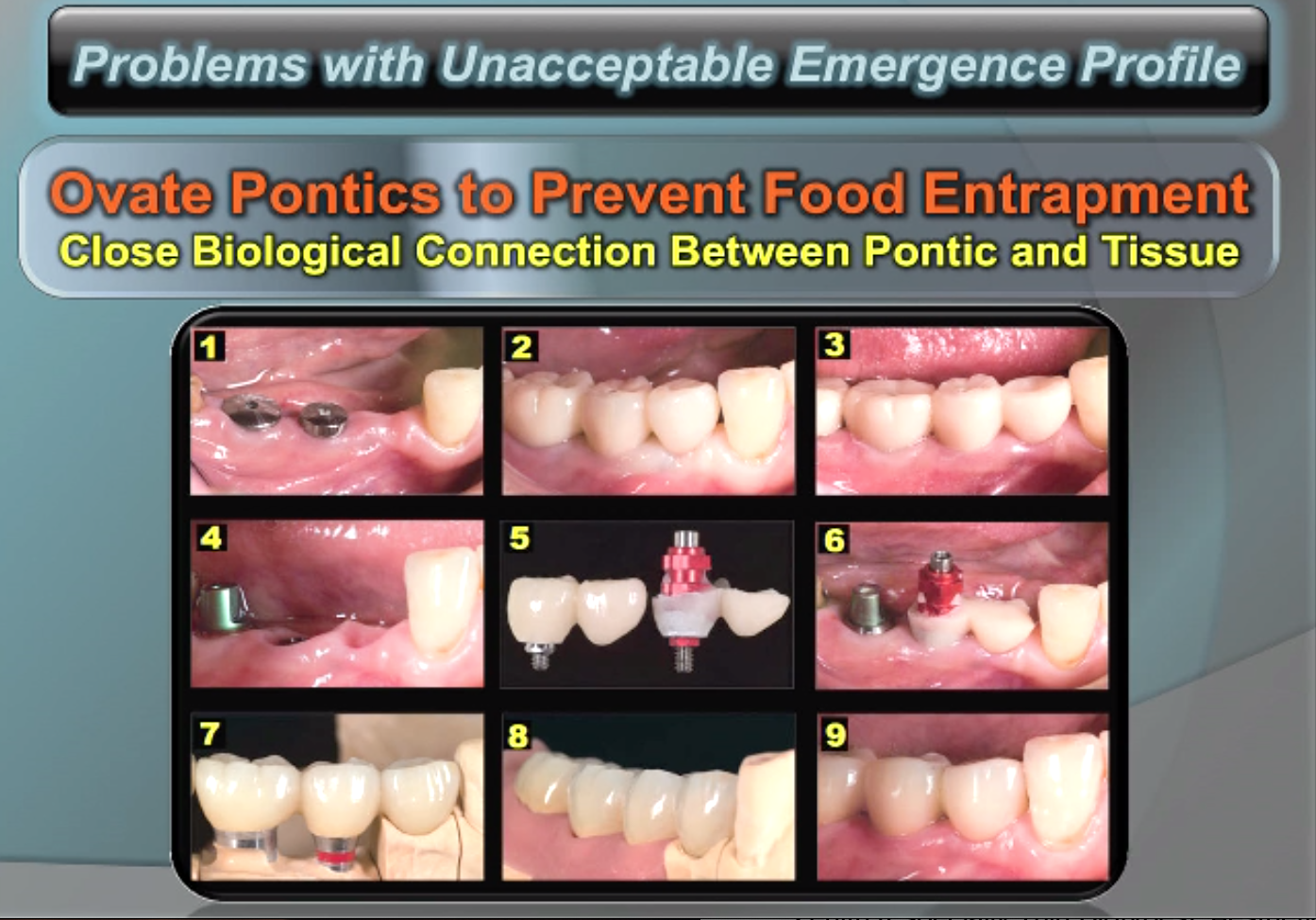
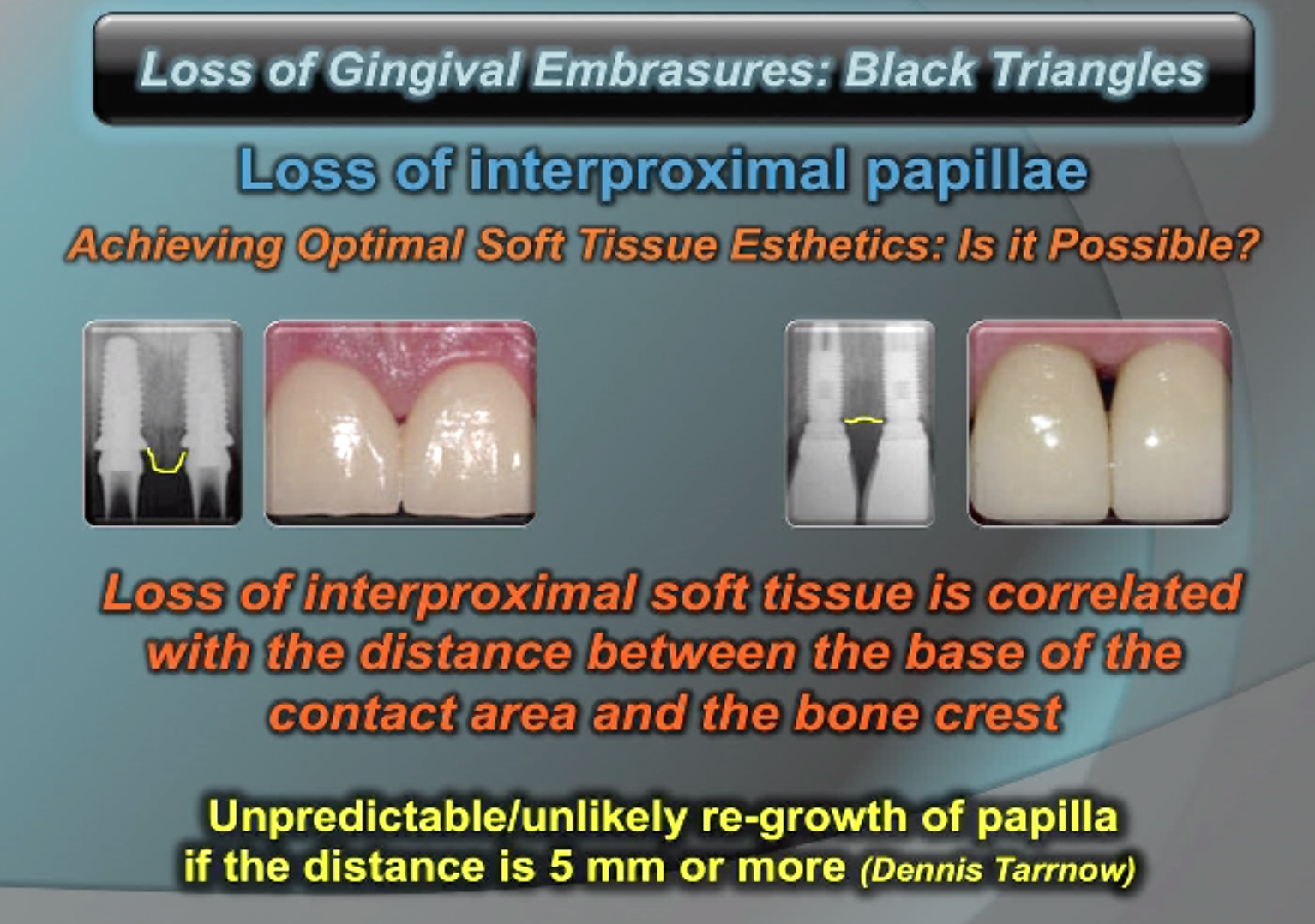
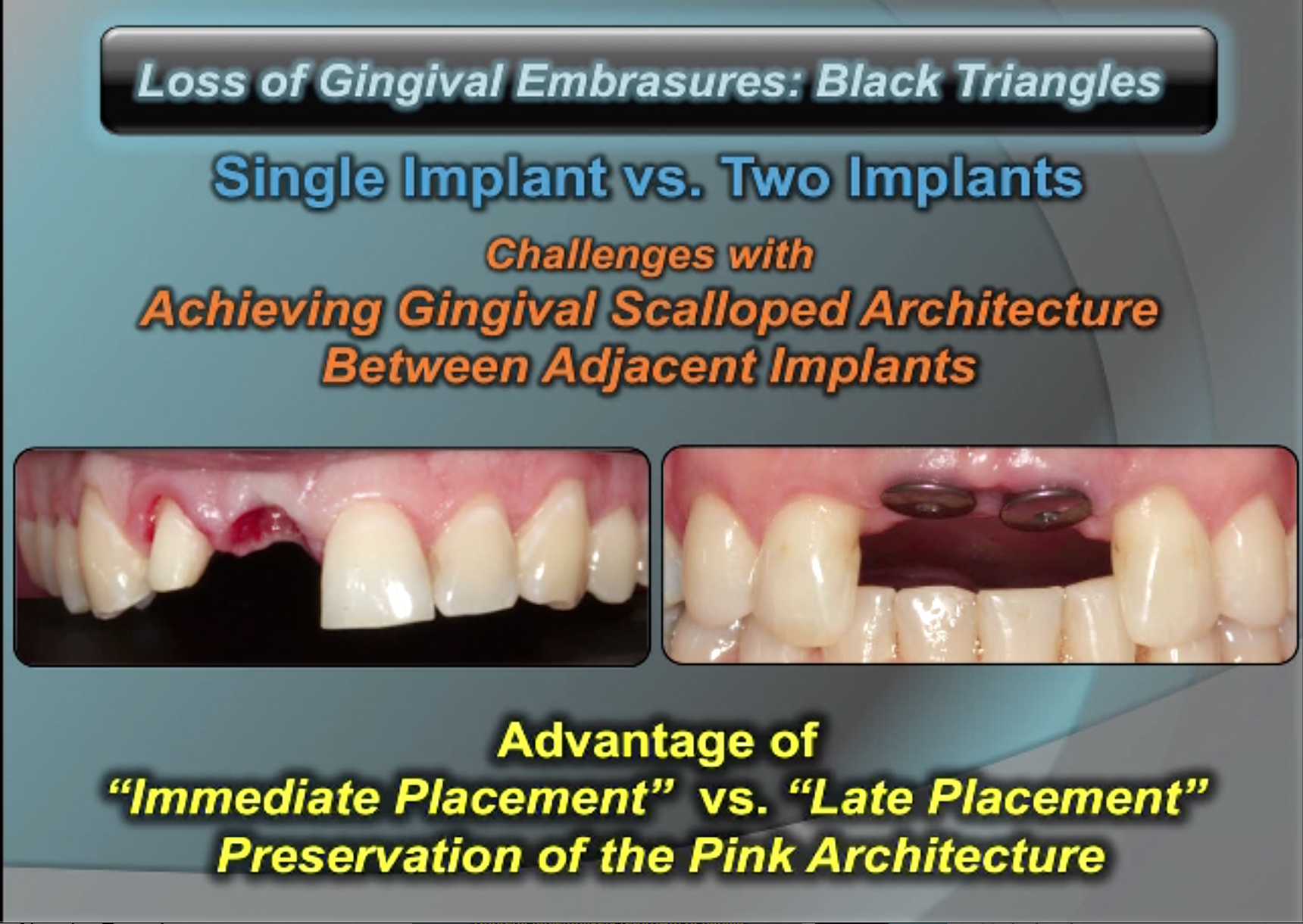
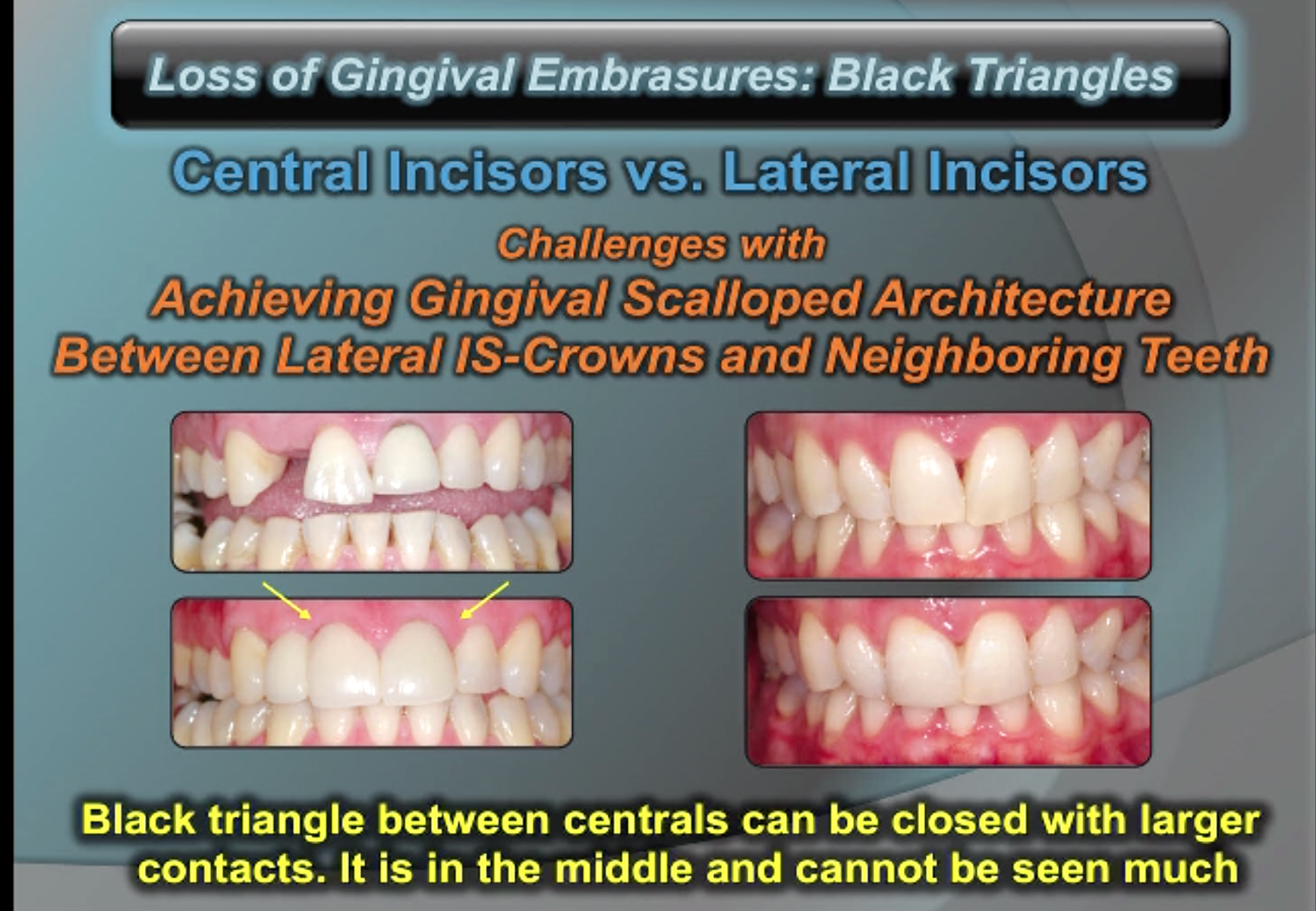
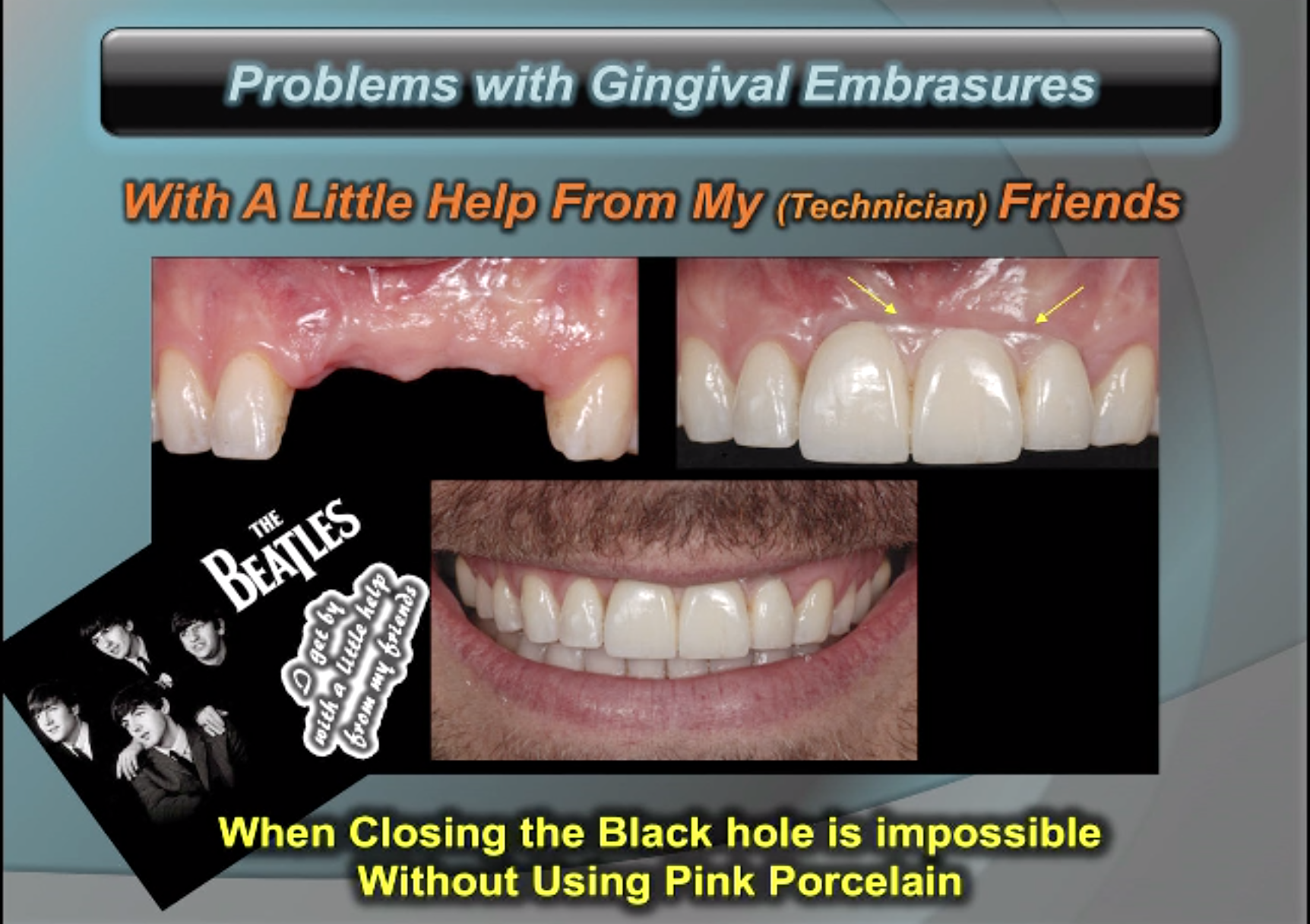
9 Improper design of the gingival embrasure in esthetic zone, inadequate use of temporaries. Black hole view
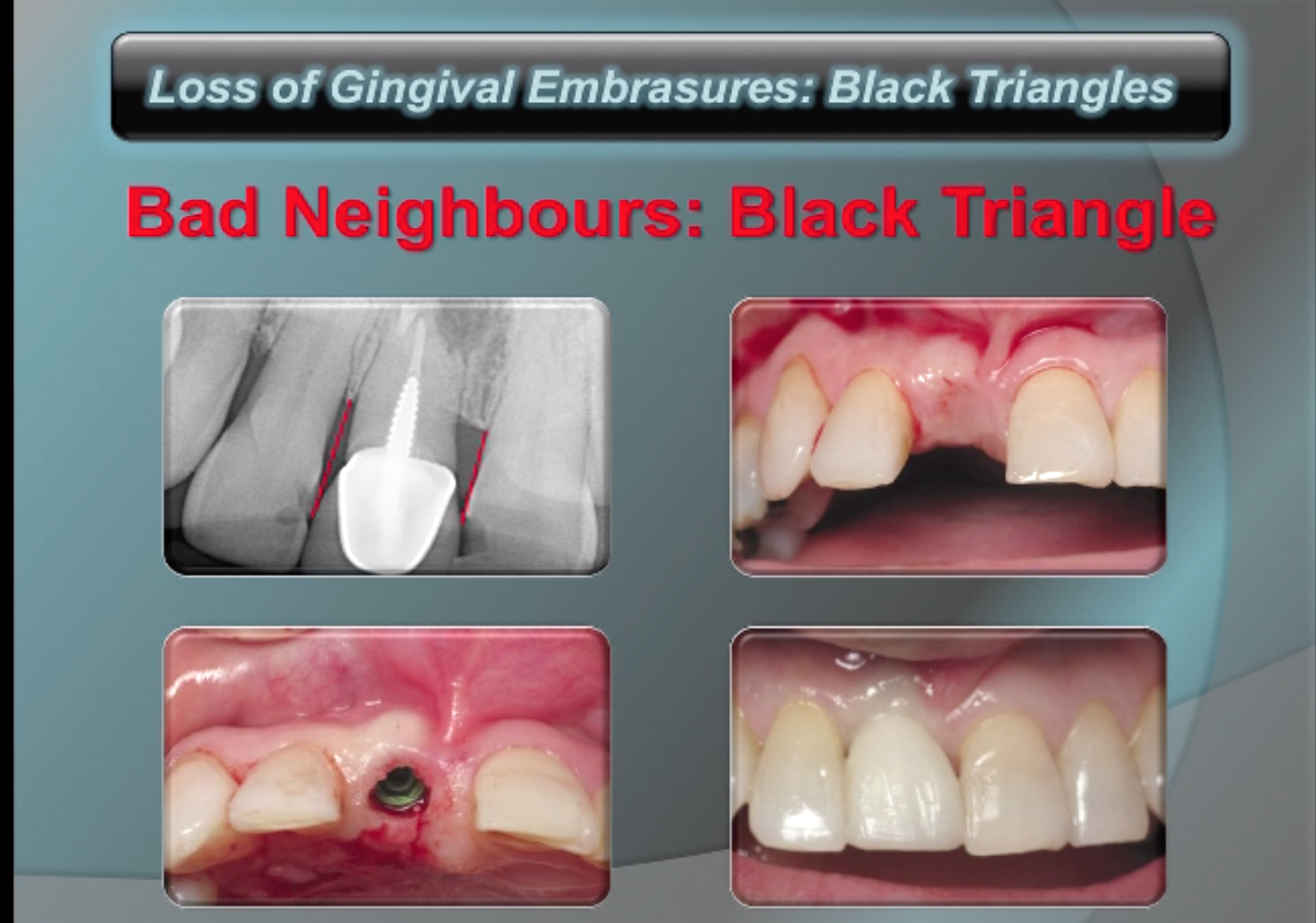
10 Bad Neighbors!!! Bone loss of the adjacent teeth. Black hole view.
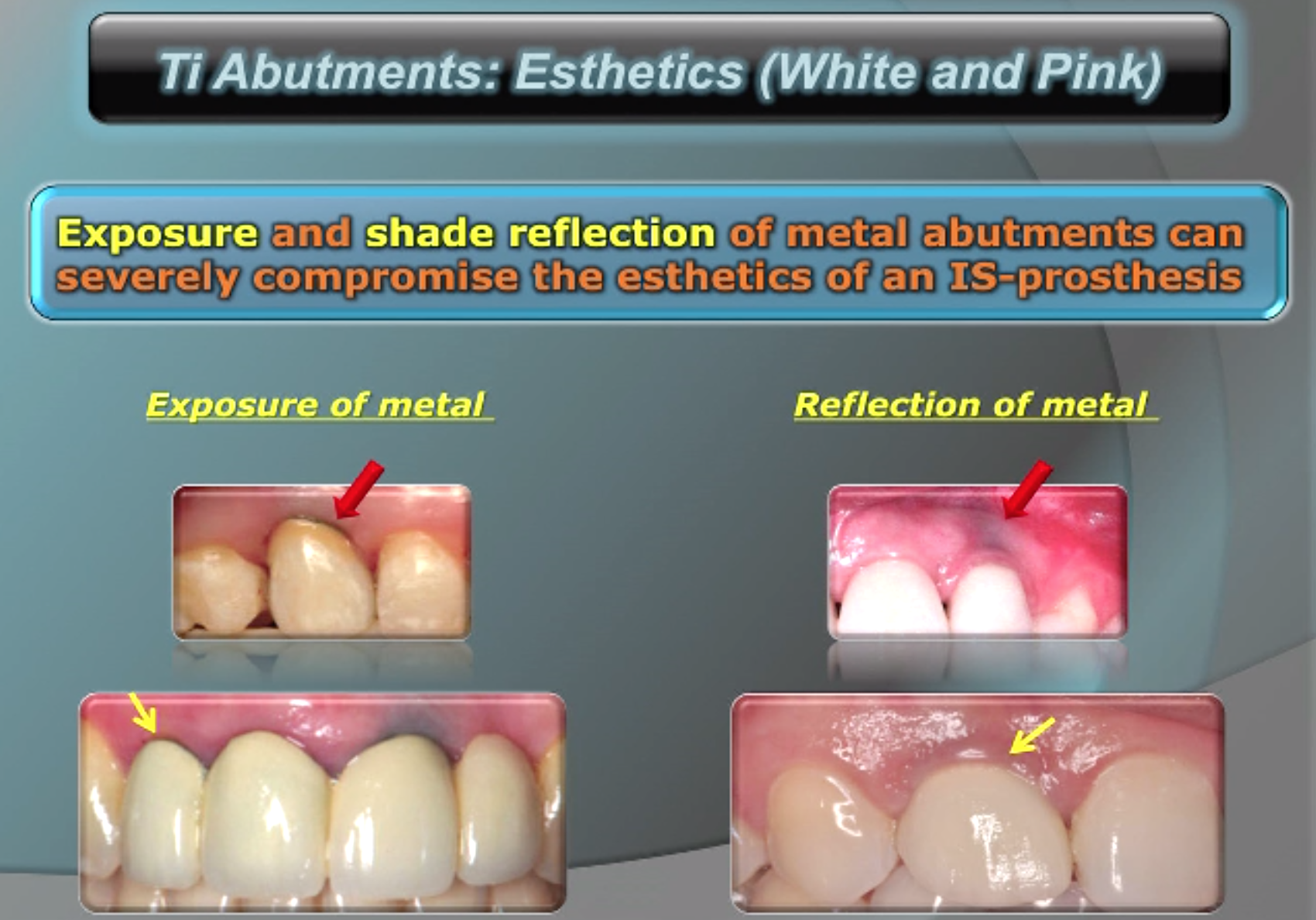
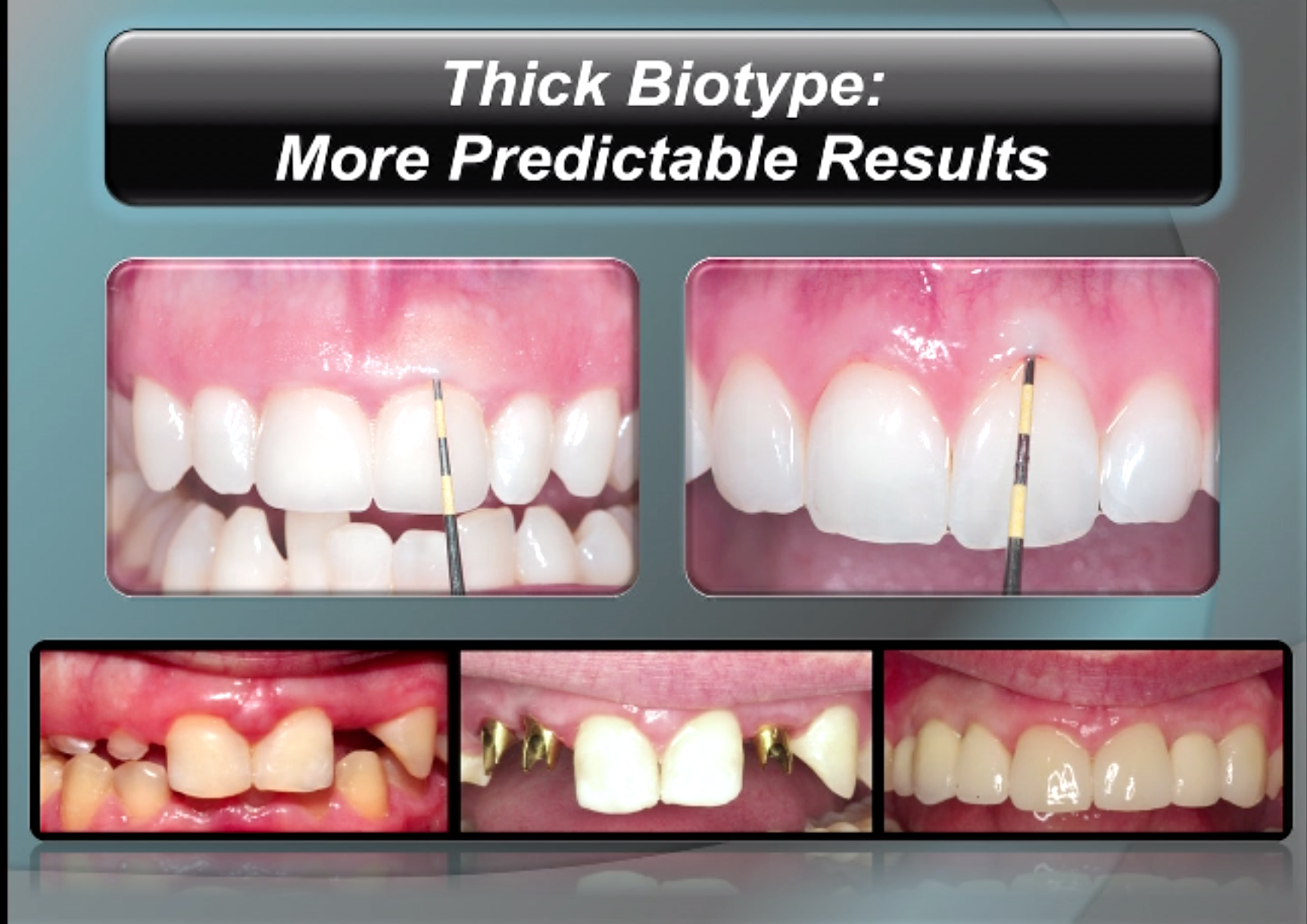
11 Esthetic Zone, Thin Biotype. Black view of the abutment, Show- through phenomenon
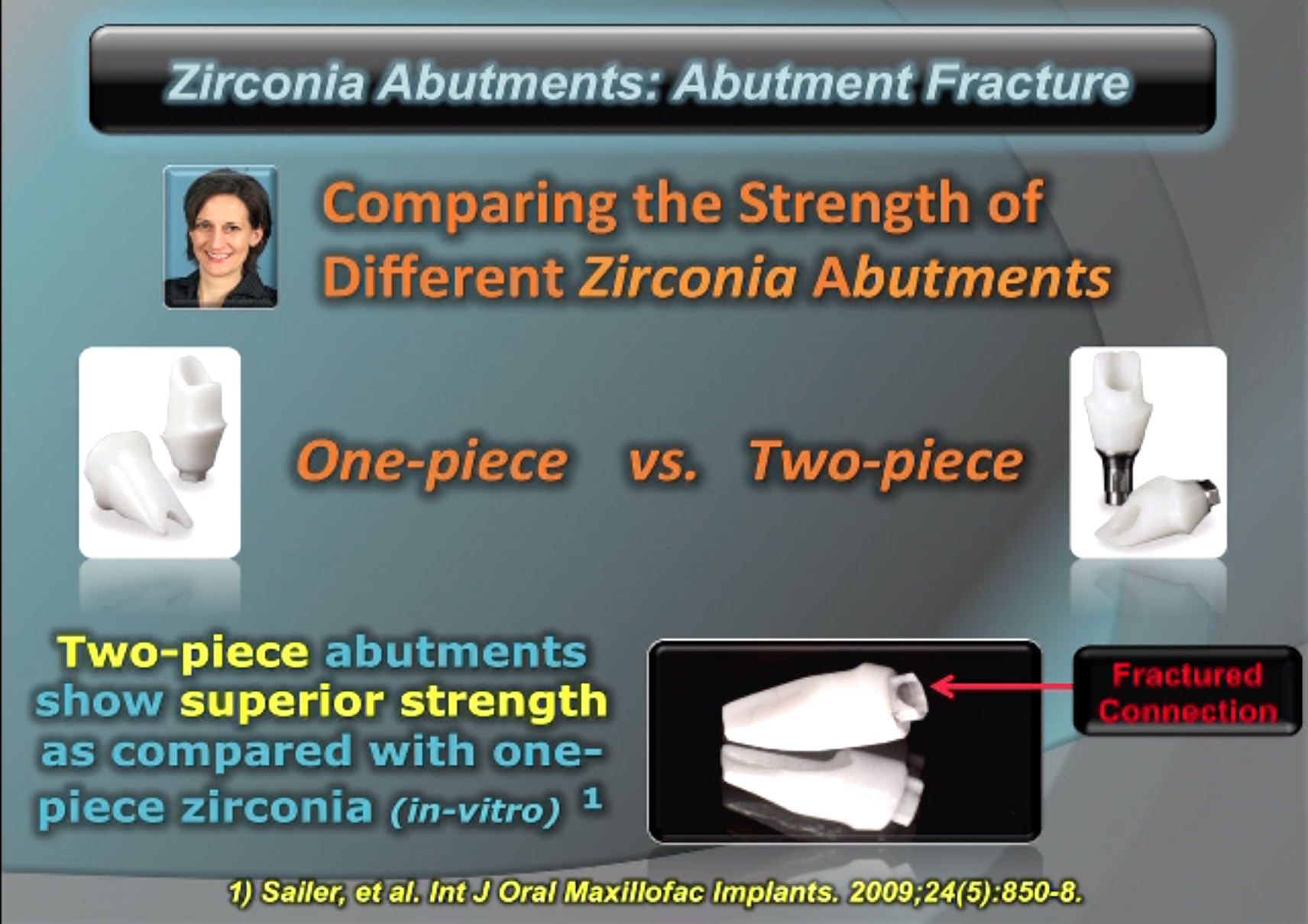
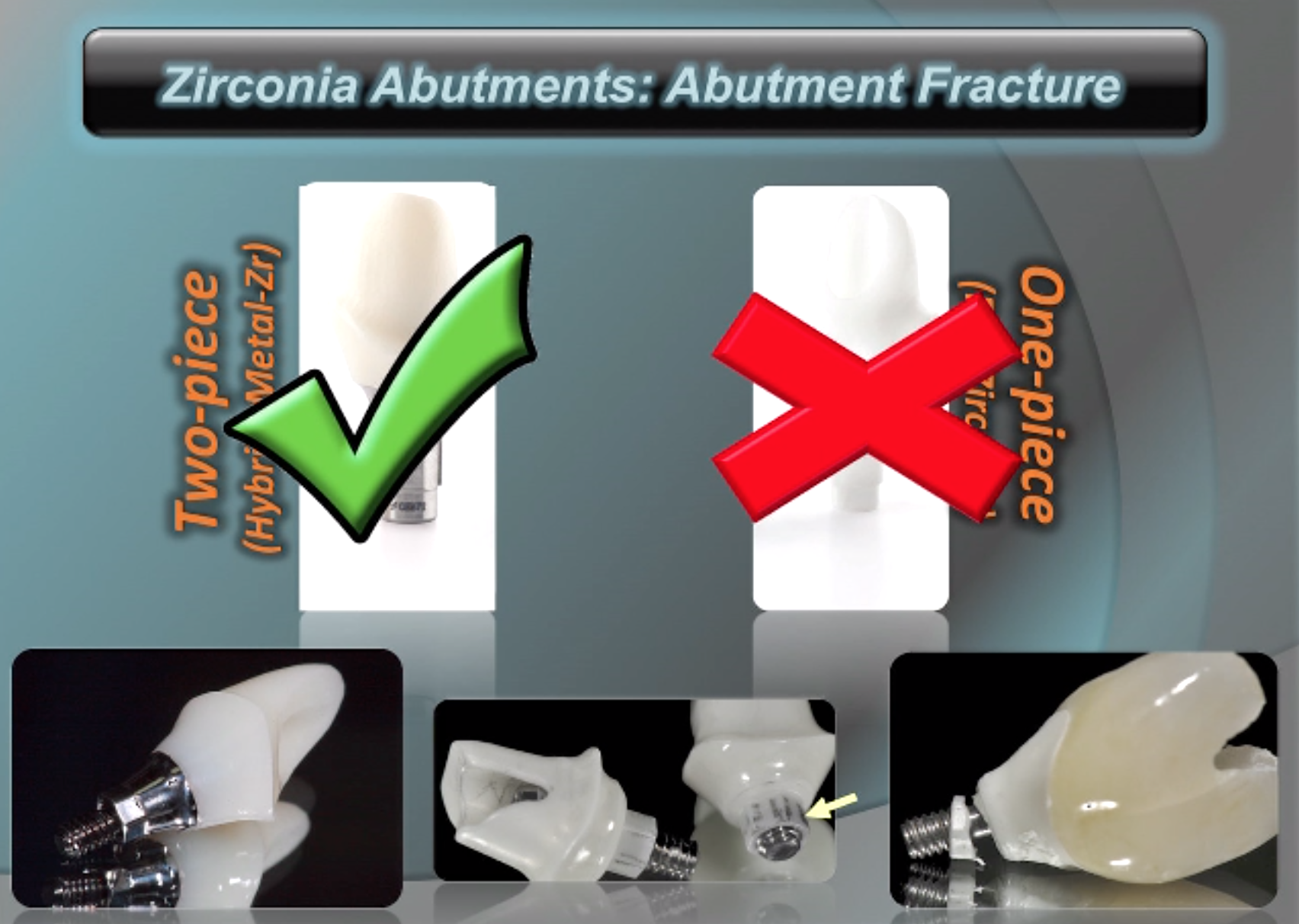
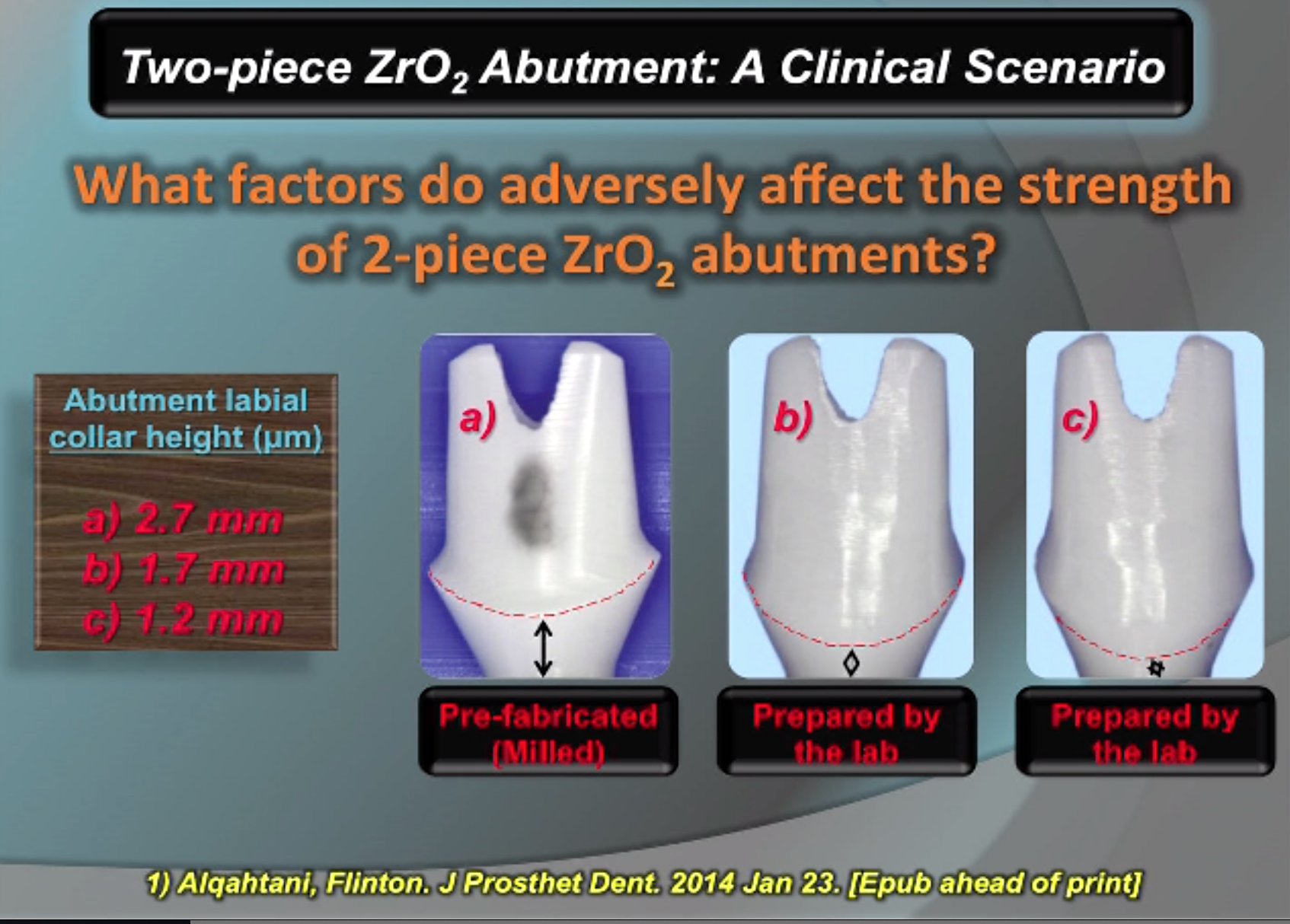
12 One-piece Zirconium abutment fracture. superiority of 2-piece Zirconium abutments over one-piece Zirconium abutments
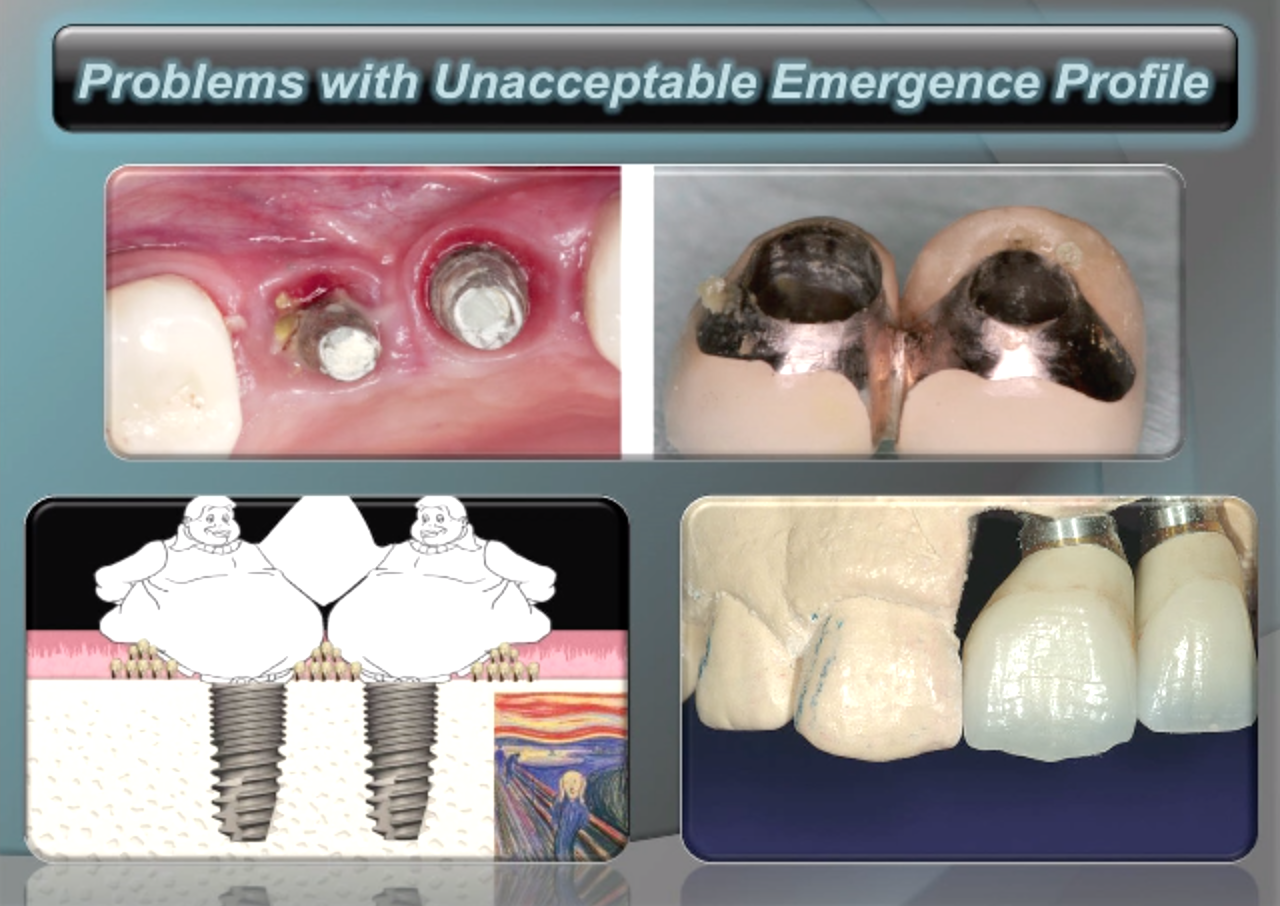
13 Over-contoured implant-Supported Crown in aesthetic zone. Apical migration of the zenith (especially thin biotypes), Aesthetic problem
14 Inaccurate closed-tray Impression due to the unblocked hole of the screw head.
15 Improper use of straight abutment for the anterior abutments in fixed implant prostheses. Fracture of the anterior teeth and acrylic
16 Lack of keratinized tissue around the implants. Lack of Junctional Epithelium. Effect on the alveolar crest.
17 Problems with cement retained crowns. Excessive cement and lack of cement-barrier. Alveolar bone loss
18 Improper design of bars in Implant supported-bar overdenture. Lack of access for oral hygiene and irritation of the tissue
19 Locator overdentures problems. The position of implants and the uneven equation of retention-stability.
20 The importance of anti-rotational element in IS-overdentures. Milled-bar vs. Locators
21 Common complication of Implant Supported-restorations. Porcelain fracture on the mesial margins, unsupported porcelain (Belsser’s presentation)
22 Immediate implant placement, esthetic complications. Thickness of buccal and palatal wall bone prior to extraction
23 Interference of the abutment base with the bone architecture. Abutment can’t be seated.
24 Incorrect height of locators. Too tall: limited space and acrylic fracture , Too short: Tissue interference, low retention
25 Inadequate stability of 2-implant dentures. Why only 2 implants? Why placing 2 implants only in the anterior area?
B) PERI-IMPLANTITIS AND ITS MANAGEMENT:
26 THE PROBLEM OF DEFINING PERI-IMPLANTITIS.
27 Cost/benefit analysis in treating in peri-implantitis.
28 Informed consent to include information on financial responsibility in case of additional surgical treatment
29 THE CHALLENGES OF RADIOGRAPHIC INTERPRETATION
30 CONFUSION OF CAUSE AND EFFECT IN PERI-IMPLANTITIS.
31 THE CHALLENGE OF EFFECTIVE DECONTAMINATION OF THE IMPLANT SURFACE.
32 THE CHALLENGE OF MAINTAINING A STATIC PROSTHESIS IN A DYNAMIC ENVIRONMENT
33 Assessing the feasibility of a new implant.
34 LIMITATIONS OF BONE REGENERATIVE PROCEDURES AT THE TIME OF IMPLANT PLACEMENT
35 Violating Of MINIMUM INTER-IMPLANT SPACING
36 Proper articulation of the consequences of the failure of our treatment plan and available remedies.
37 Too early replacement of teeth with implants?
38 Identifying Patients at High Risk for Peri-Implantitis.
39 Identifying Who is likely to lose his implant.
40 DISTINGUISHING PERI-IMPLANTITIS FROM PERI-IMPLANT MUCOSITIS.
41 Challenges in interpreting probing depths
42 LACK OF ROUTINE MONITORING OF IMPLANTS
43 INTERPRETING BONE LOSS AROUND IMPLANTS: not always peri- implantitis!
44 How to distinguish peri-implantitis from loss of integration due to occlusal overload
45 Deterioration/Corrosion of the implant surface and effects on the surrounding tissues.
46 Challenges in visualizing peri-implant defect morphology based on radiographs
47 Challenges in interpreting implant mobility.
48 IMPLANTS IN PERIODONTALLY COMPROMISED PATIENTS
49 Level of insertion of the implant and its effect on peri-implant pocket depth:
50 Not accounting for bone remodelling in the case of immediate implant placement
C: Anatomical Complications in Implantology:
51 THE INFERIOR alveolar NERVE
52 THE MENTAL NERVE
53 THE LINGUAL NERVE
54 THE GREATER Palatine ARTERY
55 THE MAXILLARY ARETRY
56 THE INTER-FORAMINAL AREA
57 THE MAXILLA AND ITS NERVES
58 THE MAXILLARY SINUS
59 SINUS PROBLEMS
60 BLEEDING (HEMORRAGE)
61 THE RESPIRATORY SYSTEM
62 WHAT CAN FALL THRE IN THE RESPIRATORY SYSTEM
63 LOSS OF SENSATION
64 PERIIMPLANTITIS ANDMUCSITIS
65 FATAL AIREMBOLISM
66 MANDIBULAR FRACTURE
67 POST OPERATVE COMPLICATION
68 HEMATOMA
69 OPENING THE NASAL OR MAXILLARY SINUS
70 PERFORATION OF THE LINGUAL SURFACE
71 BROKEN BUR
72 PREVENTIVE METHODS
73 RADIOLUCENCY
74 THE DANGEROUS FACE TRIANGLE
75 CONNECTIONS FROM THE DANGEROUS Areas OF THE FACE
D) Laboratory related Complications in Implantolgy:
76 Should I assemble the analogs on the impression copings before sending to the lab?
77 Why do I need a full arch impression?
78 When is it time to take a new impression?
79 Can I use old components (impression copings, analogs?)
80 How to take an implant impression
81 Why do we need a soft tissue model?
82 Should I use a plastic or metal articulator?
83 Do I have to take a new opposing model?
84 Pick up impression of an implant bridge.
85 Open or closed tray? What is the difference?
86. Verification jig – do I need it?
87 Do I need engaging impression copings take an impression?
88 Why are my crowns high? Do I need an X-ray?
89 Can I take off a solid abutment after I take an impression?
90 Diagnostic wax up – is there any value?
91 Why cast? Do CAD-CAM for a perfect fit
92 CAD–CAM copy mill
93 Outsourcing – a good way to get CAD-CAM frameworks.
94 What is the A/P spread?
95 How long will my restoration last?
96 Can I do metal-free restoration on implants?
97 What are the risks of making metal free restorations?
96 How often should I replace Locators?
99 Why are the denture teeth breaking off?
100 Designing the right bar.
Related Products


Reviews
There are no reviews yet.